
Faculty of Business and Management Sciences conduct curriculum transformation workshop
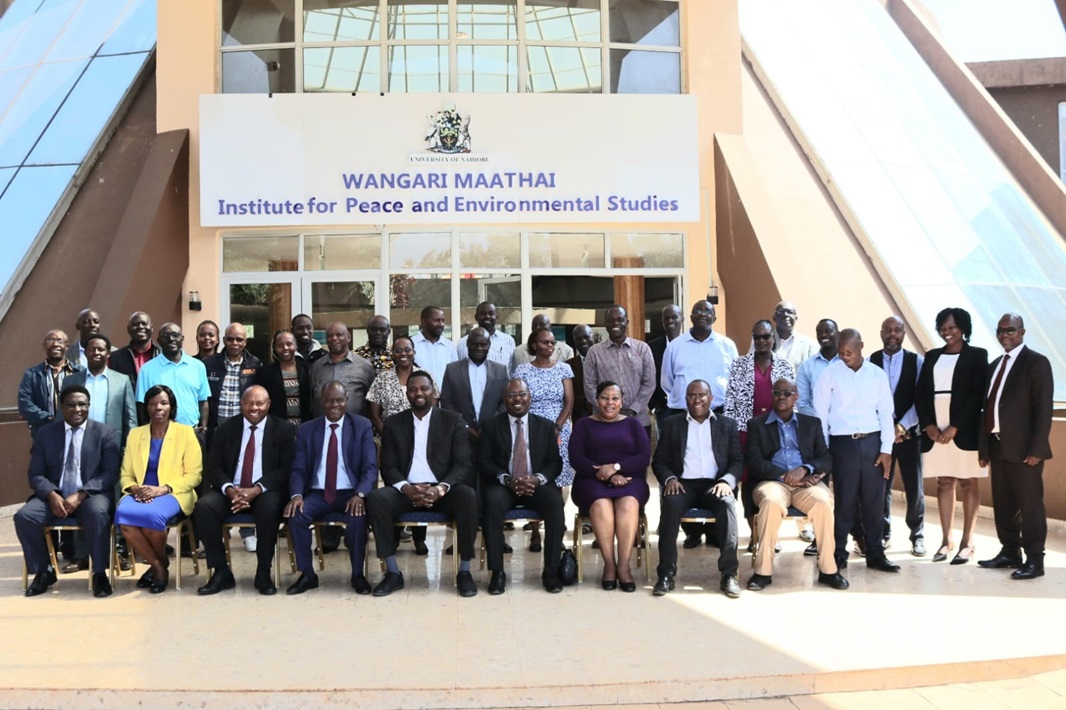
The Faculty of Business and Management Sciences has initiated a major curriculum review to bridge the gap between academic theory and industry demands. The move follows a three-day intensive curriculum transformation workshop held from February 11–13, 2026, at the Wangari Maathai Institute, organized in partnership with the Qatar University and funded by Qatar Fund for Development.
Speaking during the sessions, Prof. Kennedy Ogollah, Dean of the Faculty of Business and Management Sciences, termed the review critical for the faculty's future. He emphasized that the university can no longer rely on traditional teaching methods, the focus must shift to experiential learning and technology-driven instruction that mirrors real-world challenges. "We must use sessions like this to explore experiential learning models, collaborative projects, and technology-enhanced methods of learning and teaching," Prof. Ogollah told the attendees.
The workshop comes as Kenya prepares for the full rollout of Competency-Based Education and Training (CBET) across higher education institutions. Prof. Ayub Gitau, Deputy Vice-Chancellor (Academic Affairs), represented the Vice-Chancellor and commended the Qatar partnership as a strategic step toward better academic quality. "We can no longer rely on traditional content-heavy approaches that produce graduates who can recite theory but struggle to apply it," Prof. Gitau said. "This partnership pushes us to prioritize competence, innovation, and measurable impact. We need graduates who solve problems, not just pass exams."
The technical sessions were led by Prof. Habib Mahama from Qatar University’s College of Business and Economics. He challenged faculty members to stop viewing their subjects in isolation. "A curriculum system is not merely a collection of courses but an integrated structure where graduate attributes, course content, learning outcomes, teaching strategies, and assessment methods are aligned," Prof. Mahama explained. He guided the faculty through designing graduate attributes the reflect desired competencies, translating the attributes into program and course learning outcomes, and how to embed these outcomes into courses, learning and teaching activities; ensuring that every course contributes directly to the graduate attributes.
Preparing for the CBET Rollout
Prof. Rosemary Imonje from the Department of Educational Management, Policy and Curriculum Studies explained Kenya's Competency-Based Education Training framework and what it means for universities. She stressed that CBET represents a fundamental shift in how institutions approach teaching and assessment. "CBET is not just another curriculum tweak. It's a complete paradigm shift from knowledge accumulation to competence demonstration," Prof. Imonje said. "The question is no longer 'what do students know?' but 'what can they actually do with what they know?'"
She presented the proposed CBET model for the University of Nairobi and didn't downplay the challenges ahead. "By 2029, we'll receive our first CBET cohort. That gives us three years to restructure our programs, retrain faculty, and redesign our assessment systems," Prof. Imonje noted. "The infrastructure, mindset, and pedagogical shifts required are substantial, but necessary if we want to remain relevant."
Prof. James Njihia from the Department of Management Sciences and Project Planning said business education must reflect how modern organizations actually operate. "It is important that we explore experiential learning models together to effectively redesign our course outlines," he said.
By the close of the workshop, faculty members had begun mapping new graduate attributes, signaling a decisive move toward a more responsive and practical business education at the university.
The curriculum Transformation workshop marks a concrete step in the Faculty's preparation for the 2029 CBET transition. Faculty members are now developing redesigned course frameworks based on competency-based pedagogy learned during the three days.

